







-

USS TENNESSEE CAMO BATTLESHIP (BB-43)
SAVY DIRECT PRICE $899.96MSRP: $949.99USS TENNESSEE CAMO BATTLESHIP (BB-43) FULLY BUILT AND READY TO DISPLAY MUSEUM QUALITY SHIP MODEL Dimension approx.: 38″ L x 7.5″ W x 14″ H The model is already built. THIS IS NOT A MODEL SHIP... -
 img:new-low-5-bottom-with-special-offer-08042026.pngimg:new-low-5-bottom-with-special-offer-08042026.png
USS IOWA BATTLESHIP (BB-61)
SAVY DIRECT PRICE $100.00 - $899.96USS IOWA BATTLESHIP (BB-61) FULLY BUILT AND READY TO DISPLAY, QUALITY SHIP MODEL Dimension approx.: 40″ L x 5″ W x 12.5″ H Approx. scale 1/350 This beautiful model is already built, NOT a kit. -
USS NEBRASKA BATTLESHIP (BB-14)
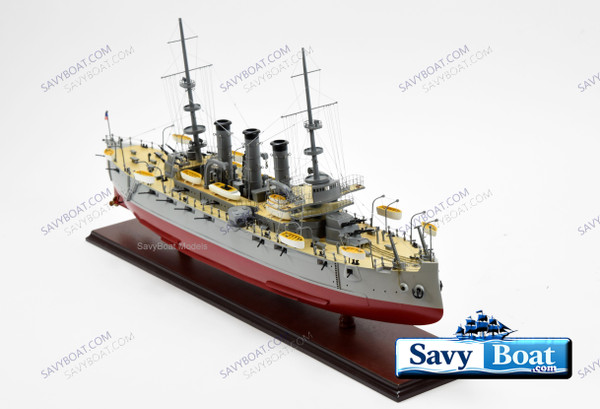
SAVY DIRECT PRICE $899.96MSRP: $999.99USS Nebraska (BB-14) — Virginia-Class Battleship FULLY BUILT AND READY TO DISPLAY MUSEUM QUALITY SHIP MODEL Dimension approx.: 32″ L x 6″ W x 15″ H. The model is already built. THIS IS NOT A MODEL...
Description

USS WEST VIRGINIA BATTLESHIP (BB-48) CAMO
FULLY BUILT AND READY TO DISPLAY MUSEUM QUALITY SHIP MODEL
- Dimension approx.: 33″L x 5.5″W x 11″H
- The model is already built. THIS IS NOT A MODEL SHIP KIT
Commissioned in 1923 as the last of the Colorado‑class battleships, the USS West Virginia (BB‑48) entered the fleet at a moment when the United States Navy was perfecting its “standard‑type” battleship doctrine. These ships—uniform in speed, armor layout, and tactical handling—were designed to fight together as a cohesive battle line. West Virginia embodied that philosophy completely: heavily armored, powerfully armed, and built to stand in the line of battle against any capital ship afloat.
Her main battery of eight 16‑inch/45 caliber guns, mounted in four twin turrets, gave her a punch unmatched by earlier American battleships. A secondary battery of sixteen 5‑inch guns, supplemented by anti‑aircraft weapons and torpedo tubes, made her a formidable opponent at any range. Her armor belt reached 13.5 inches, her turret faces 18 inches, and her conning tower 16 inches—a floating fortress designed to absorb punishment and keep fighting. Beneath her decks, advanced watertight compartmentation improved her survivability, reflecting lessons learned from World War I.
Throughout the 1920s and 1930s, West Virginia participated in Fleet Problems, the large‑scale naval exercises that shaped American strategy in the Pacific. These annual maneuvers tested her crew, refined gunnery and damage‑control techniques, and prepared the ship for the conflict many believed would one day come across the Pacific Ocean. With a speed of 21 knots and long cruising range, she could operate from the Atlantic to Hawaii, projecting American naval power wherever needed.
Her intended role was clear:
-
Engage enemy battleships in decisive fleet action
-
Provide heavy coastal bombardment
-
Serve as a deterrent through overwhelming firepower
-
Anchor the battle line in any major Pacific engagement
She was built for the kind of war the world expected—line‑of‑battle duels between heavily armored giants. History, however, would test her in ways her designers never imagined.
On December 7, 1941, West Virginia was moored at Pearl Harbor when Japanese aircraft attacked. She was struck by multiple torpedoes and bombs, sinking at her berth but settling upright thanks to her compartmentation. Her survival—though badly damaged—proved the value of her design. Raised, rebuilt, and modernized, she would later return to fight in the Pacific with renewed strength. But even before her dramatic wartime comeback, her original purpose as a standard‑type battleship defined her place in naval history.


