













-
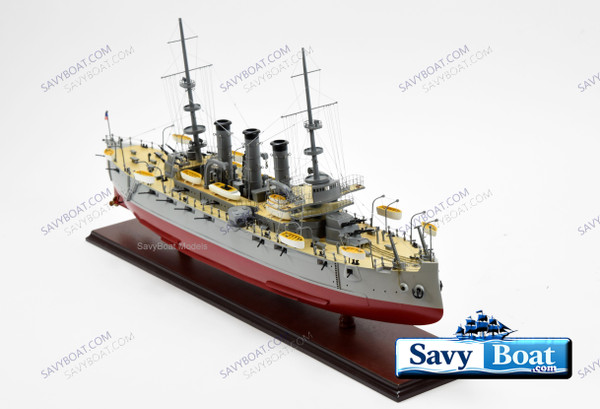
USS NEBRASKA BATTLESHIP (BB-14)
SAVY DIRECT PRICE $899.96MSRP: $999.99USS Nebraska (BB-14) — Virginia-Class Battleship FULLY BUILT AND READY TO DISPLAY MUSEUM QUALITY SHIP MODEL Dimension approx.: 32″ L x 6″ W x 15″ H. The model is already built. THIS IS NOT A MODEL... -
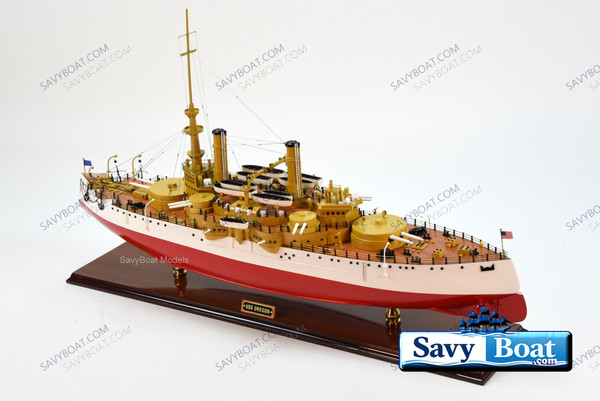
USS OREGON BATTLESHIP BB-3
SAVY DIRECT PRICE $924.96MSRP: $999.99USS OREGON BATTLE SHIP BB-3 (YELLOW) FULLY BUILT AND READY TO DISPLAY, QUALITY SHIP MODEL Dimension approx.: 34″ L x 8.5″ W x 20″ H -

USS WISCONSIN BATTLESHIP (BB-64)
SAVY DIRECT PRICE $899.96MSRP: $999.99USS WISCONSIN BATTLESHIP (BB-64) FULLY BUILT AND READY TO DISPLAY MUSEUM QUALITY SHIP MODEL Dimension approx.: 40″ L x 5″ W x 12.5″ H Appro
Description

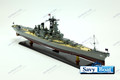
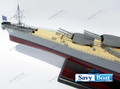
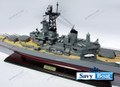
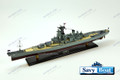
USS IOWA BATTLESHIP (BB-61)
FULLY BUILT AND READY TO DISPLAY, QUALITY SHIP MODEL
- Dimension approx.: 40″ L x 5″ W x 12.5″ H
- Approx. scale 1/350
- This beautiful model is already built, NOT a kit.
When the USS Iowa (BB‑61) took shape at the New York Naval Shipyard in 1940, she represented the beginning of a new generation of American sea power. Ordered on the eve of global conflict and launched in August 1942, she was the first of the Iowa‑class fast battleships—sleek, powerful, and built to escort carriers at high speed across the world’s oceans. With her nine 16‑inch/50 caliber Mark 7 guns, twenty 5‑inch/38s, and layers of Bofors and Oerlikon anti‑aircraft batteries, she embodied the pinnacle of battleship design at the moment when naval warfare was rapidly evolving.
Commissioned on 22 February 1943, Iowa began her career in the Atlantic, where she carried President Franklin D. Roosevelt to the Casablanca and Tehran Conferences. The voyage produced one of the most famous near‑misses in naval history: a torpedo accidentally launched by her escort, USS William D. Porter, narrowly avoided striking the battleship carrying the Commander‑in‑Chief. It was a moment that became legend—an early reminder of the stakes and unpredictability of war at sea.
In January 1944, Iowa steamed into the Pacific as flagship of Battleship Division 7. There she joined the fast carrier task forces that formed the striking arm of the U.S. Navy. She supported the Marshall Islands campaign, took part in raids on Truk, and played a decisive role in the Battle of the Philippine Sea, where American naval aviation shattered Japanese carrier power. Her guns thundered in support of landings on Saipan, Tinian, Guam, and Peleliu, and in the final months of the war she bombarded industrial targets in Hokkaido and Honshu. On 2 September 1945, she stood in Tokyo Bay as Japan formally surrendered, witnessing the end of the conflict she had helped win.
Decommissioned in 1949, Iowa returned to service for the Korean War in 1951, this time as flagship of the Seventh Fleet. Her 16‑inch guns—designed for duels with enemy battleships—became instruments of coastal bombardment, firing more than 16,600 rounds against targets at Songjin, Hungnam, Kojo, and Inchon. After the armistice, she served with the Atlantic Fleet, participated in NATO exercises, and was retired again in 1958.
But the battleship era was not quite finished.
In 1984, during the Reagan administration’s 600‑ship Navy expansion, Iowa was modernized and recommissioned. Her anti‑aircraft guns were removed, and she received a new arsenal: 32 Tomahawk cruise missiles, 16 Harpoon anti‑ship missiles, Phalanx CIWS, upgraded radar, electronic warfare systems, and even UAVs for gunfire spotting. She deployed across the Atlantic, Mediterranean, and Indian Ocean, serving as a missile‑armed capital ship in the Cold War’s final decade.
Then came tragedy. On 19 April 1989, an explosion in her No. 2 turret killed 47 sailors, one of the worst peacetime accidents in U.S. naval history. Investigations were contentious, but later reviews concluded the cause was likely an accidental powder explosion. Despite the loss, Iowa continued operations until her final decommissioning on 26 October 1990, closing nearly half a century of service.
Today, the USS Iowa rests at Berth 87 in Los Angeles, preserved as a museum ship and living monument to the sailors who served aboard her. She earned 11 battle stars, carried a president, fought in two wars, and adapted to the missile age—an American battleship that bridged eras, from the age of big guns to the dawn of modern naval warfare.
She remains a symbol of power, innovation, and resilience—one of the last great battleships, still commanding attention long after her guns fell silent.


