




-
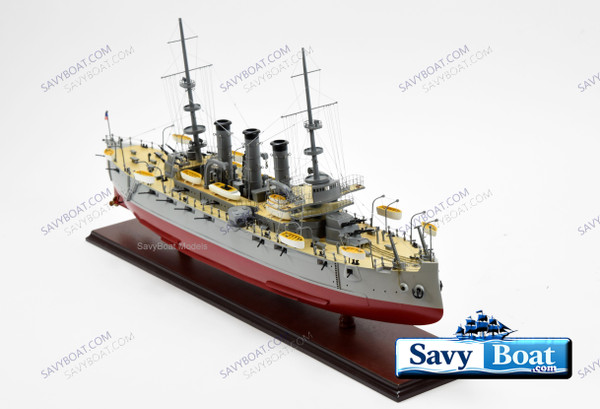
USS NEBRASKA BATTLESHIP (BB-14)
SAVY DIRECT PRICE $899.96MSRP: $999.99USS Nebraska (BB-14) — Virginia-Class Battleship FULLY BUILT AND READY TO DISPLAY MUSEUM QUALITY SHIP MODEL Dimension approx.: 32″ L x 6″ W x 15″ H. The model is already built. THIS IS NOT A MODEL... -
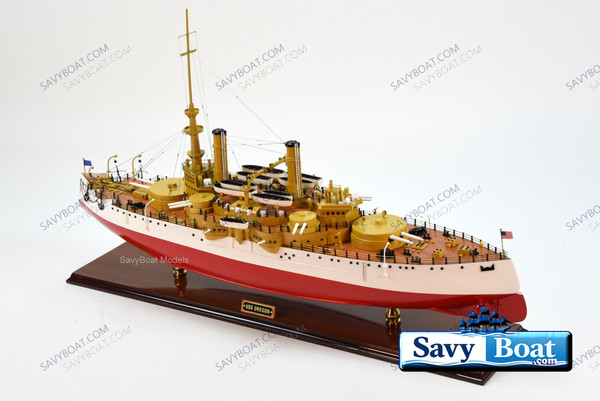
USS OREGON BATTLESHIP BB-3
SAVY DIRECT PRICE $924.96MSRP: $999.99USS OREGON BATTLE SHIP BB-3 (YELLOW) FULLY BUILT AND READY TO DISPLAY, QUALITY SHIP MODEL Dimension approx.: 34″ L x 8.5″ W x 20″ H -

USS WISCONSIN BATTLESHIP (BB-64)
SAVY DIRECT PRICE $899.96MSRP: $999.99USS WISCONSIN BATTLESHIP (BB-64) FULLY BUILT AND READY TO DISPLAY MUSEUM QUALITY SHIP MODEL Dimension approx.: 40″ L x 5″ W x 12.5″ H Appro
Description

USS PENNSYLVANIA BATTLESHIP (BB-38)
FULLY BUILT AND READY TO DISPLAY MUSEUM QUALITY SHIP MODEL
- Dimension approx.: 36″L x 6″W x 12.5″H
- The model is already built. THIS IS NOT A MODEL SHIP KIT
USS Pennsylvania (BB‑38) entered the fleet in June 1916 as the lead ship of the Pennsylvania‑class super‑dreadnoughts—broad‑shouldered, heavily armored giants built to anchor America’s emerging standard‑type battle line. She carried twelve 14‑inch guns, more than any U.S. battleship before her, and embodied the Navy’s shift toward oil‑burning propulsion. As your document notes, “Equipped with an oil‑burning propulsion system, Pennsylvania was not sent to European waters during World War I… Instead, she remained in American waters and took part in training exercises.” Her wartime role was quiet but symbolic: in December 1918 she escorted President Woodrow Wilson to France for the peace negotiations.
Through the 1920s and 1930s, Pennsylvania became the steady heartbeat of the fleet. She served as flagship of the Atlantic Fleet, then the Battle Fleet, and spent most of her peacetime career based at San Pedro, California. Her days were filled with Fleet Problems, port visits, and long cruises—including a celebrated voyage to Australia in 1925. Between 1929 and 1931, she underwent a major modernization that strengthened her armor, improved her machinery, and updated her guns for greater range. By the late 1930s, she was one of the most polished and capable battleships in the Pacific.
On 7 December 1941, Pennsylvania was in Dry Dock No. 1 at Pearl Harbor, undergoing refit alongside the destroyers Cassin and Downes. This unusual positioning saved her from the torpedoes that devastated Battleship Row. Still, she fought hard. As the document recounts, “between 08:02 and 08:05, her anti‑aircraft gunners began engaging the hostile aircraft… one scored a hit on Pennsylvania that passed through the boat deck and exploded in casemate No. 9.” She suffered casualties and endured explosions from the burning destroyers beside her, yet remained afloat and seaworthy. By late December she was repaired enough to sail for San Francisco, where her anti‑aircraft battery was modernized for the long Pacific war ahead.
From 1943 onward, Pennsylvania became a relentless shore‑bombardment battleship, delivering heavy fire in support of amphibious landings across the Pacific. She fought in the Aleutians, bombarding Attu and Kiska; then at Makin, Kwajalein, Eniwetok, and throughout the Marianas and Palau campaign—Saipan, Guam, Peleliu, and Angaur. At Surigao Strait, she was present for the last battleship‑versus‑battleship action in history, though her older radar prevented her from locating targets in the night battle.
Her final combat came at Okinawa, where she endured relentless air attack. A Japanese torpedo bomber struck her late in the campaign, inflicting severe damage and forcing her withdrawal just days before the war’s end. The blow effectively ended her frontline service.
In 1946, Pennsylvania was assigned to Operation Crossroads, the first postwar atomic bomb tests at Bikini Atoll. She was repaired only enough to make the voyage. As your document states, “She survived both blasts, but was badly contaminated with radioactive fallout from the second test.” Towed to Kwajalein, she spent a year and a half as a radiological study hulk before being scuttled in deep water in February 1948.
USS Pennsylvania lived through the full arc of the battleship era—from the rise of the super‑dreadnought to the dawn of nuclear weapons. She survived Pearl Harbor, supported nearly every major amphibious assault in the Central Pacific, and ended her days as a witness to the atomic age. Her story is one of endurance, transformation, and service across three decades of American naval history.


