





-

VIKING CLINKER BUILT ANCIENT SHIP
SAVY DIRECT PRICE $349.96MSRP: $399.99VIKING CLINKER-BUILT ANCIENT SHIP FULLY BUILT AND READY TO DISPLAY MUSEUM QUALITY SHIP MODEL Dimension approx.: 16″ (long) x 9.5″ (wide) x 9.5″ (high) The model is already built. THIS IS NOT A... -

OSEBERG ANCIENT VIKING SHIP
SAVY DIRECT PRICE $599.96MSRP: $649.99OSEBERG ANCIENT VIKING SHIP FULLY BUILT AND READY TO DISPLAY MUSEUM QUALITY SHIP MODEL Dimension approx.: 34L x 8W x 18H (inches) The model is already built. THIS IS NOT A MODEL SHIP KIT The... -

KRAGEROTERNA CLINKER BUILT 31" SAIL BOAT
SAVY DIRECT PRICE $579.96MSRP: $599.99KRAGEROTERNA CLINKER BUILT SAIL BOAT FULLY BUILT AND READY TO DISPLAY QUALITY SHIP MODEL Dimension Approx.: 31.5″L x 9.5″W x 31″H The model is already built
Description

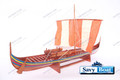
SKULDELEV CLINKER-BUILT ANCIENT VIKING SHIP
FULLY BUILT AND READY TO DISPLAY MUSEUM QUALITY SHIP MODEL
- Dimension approx.: 40″ (long) x 6″ (wide) x 20″ (high)
- The model is already built. THIS IS NOT A MODEL SHIP KIT
In the late 11th century, as the Viking Age drew toward its twilight, five ships were deliberately sunk in the narrow Peberrenden channel of Roskilde Fjord. Their purpose was defensive — a submerged barrier protecting the royal and ecclesiastical center of Roskilde from seaborne attack. For centuries they lay hidden beneath silt and cold water, until archaeologists uncovered them between 1957 and 1962, raising one of the most extraordinary collections of Viking vessels ever found.
These ships — now known as the Skuldelev fleet — reveal the full sophistication of Viking naval design. Each was built using the clinker method, where overlapping planks were fastened with iron rivets to create a hull that was light, flexible, and remarkably strong. This construction allowed Viking ships to ride over waves rather than fight them, to beach directly on shore, and to navigate waters barely a meter deep. It was a technology that carried Norse sailors across oceans and into history.
The five Skuldelev ships each tell a different story. Skuldelev 1, a broad‑shouldered cargo knarr from Norway, once hauled heavy loads — up to 24 tons — across the North Atlantic. Skuldelev 2, the largest, was a sleek warship built near Dublin, capable of carrying 70–80 warriors and flying across the water under a massive sail. Skuldelev 3 served as a Danish coastal trader, while Skuldelev 5, a nimble snekkja, patrolled fjords and shores with its crew of rowers. The smallest, Skuldelev 6, likely ferried fishermen and goods along Norway’s rugged coastline.
Together, they shattered the old myth of a single “Viking longship.” Instead, they reveal a specialized fleet — warships, traders, cargo carriers, and working boats — each crafted for a distinct purpose. Their timbers trace trade networks stretching from Norway to Ireland and Germany, while their forms reflect the strategic needs of a maritime people who relied on speed, versatility, and mastery of the sea.
Today, the Skuldelev ships rest in the Viking Ship Museum in Roskilde, where full‑scale reconstructions have proven their capabilities anew, reaching speeds of up to 14 knots under sail. Their discovery remains one of the most important windows into Viking expansion, economy, and naval ingenuity — a testament to the clinker‑built tradition that shaped centuries of exploration.


