






-

USS INDIANAPOLIS CL/CA-35 HEAVY CRUISER
SAVY DIRECT PRICE $929.96MSRP: $999.99USS INDIANAPOLIS CL/CA-35 PORTLAND CLASS HEAVY CRUISER FULLY BUILT AND READY TO DISPLAY MUSEUM QUALITY SHIP MODEL Dimension approx.: 36″ L x 4.5″ W x 10.5″ H The model is already built. THIS IS... -
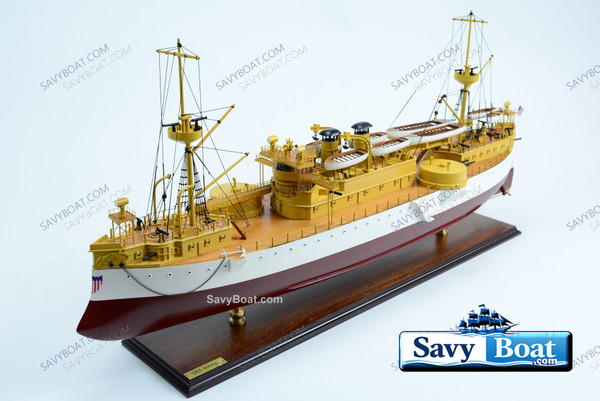
USS MAINE BATTLESHIP
SAVY DIRECT PRICE $899.96MSRP: $949.99USS MAINE SECOND CLASS BATTLESHIP FULLY BUILT AND READY TO DISPLAY, QUALITY SHIP MODEL Dimension Approx.: 32″L x 6.5″W x 14″H The model is already built, NOT a model ship kit Approximate scale... -

USS CONSTITUTION 25"
SAVY DIRECT PRICE $599.96MSRP: $639.99USS CONSTITUTION FULLY BUILT AND READY TO DISPLAY MUSEUM QUALITY SHIP MODEL LARGE MUSEUM QUALITY MODEL Dimension Approx.: 25″L x 5.5″W x 22″H The model is already built, NOT a model sh
Description

USS PHOENIX (CL-46) LT CRUISER
FULLY BUILT AND READY TO DISPLAY MUSEUM QUALITY SHIP MODEL
- Dimension approx.: 40″L x 5″W x 12.5″H
- The model is already built. THIS IS NOT A MODEL SHIP KIT
When USS Phoenix (CL‑46) first touched the water at Camden, New Jersey, on 12 March 1938, she embodied the promise of the Brooklyn‑class—sleek, fast, and armed with an extraordinary battery of fifteen 6‑inch guns. Commissioned later that year under Captain John W. Rankin, she began her life in the calm before the storm, sailing on a shakedown cruise through the Caribbean and South America. Her early voyages carried the polished diplomacy of a peacetime Navy, showing the flag in ports from Trinidad to Buenos Aires.
By 1941, Phoenix was stationed at Pearl Harbor, moored southeast of Ford Island near the hospital ship Solace. On the morning of 7 December, she found herself in the middle of the attack that would change the world. Bombs fell around her, battleships exploded nearby, but Phoenix escaped damage. Her crew brought up steam with remarkable speed, maneuvering her out of the harbor and into the search for the Japanese carriers that had launched the strike. She became one of the few major warships to emerge from the attack unscathed—a survivor of the most infamous morning in American naval history.
In the months that followed, Phoenix settled into the relentless rhythm of wartime duty. She escorted convoys between Hawaii and the West Coast, then shifted to Australian waters as Allied forces struggled to hold Southeast Asia. She carried troops to Java, participated in the chaotic evacuation of the island in early 1942, and patrolled the Indian Ocean, escorting convoys to Bombay. Her service was defined by endurance—long voyages, constant escort missions, and the steady presence of a cruiser needed everywhere at once.
By late 1943, she moved into more aggressive operations. Phoenix bombarded Cape Gloucester in New Britain, shelled Japanese positions in New Guinea, and supported amphibious landings during the long campaign to push Japanese forces from the region. She took part in raids on Madang and Alexishafen, her fifteen 6‑inch guns delivering the heavy fire that cruisers were built for. She even carried out diplomatic escort duties, including transporting Secretary of State Cordell Hull to Casablanca.
When the war ended, Phoenix returned home and was decommissioned in 1946. Her story might have ended there—but instead she began a second life under a new flag.
Sold to Argentina in 1951, she was renamed ARA 17 de Octubre, honoring a pivotal date in Argentine political history. After the fall of Juan Perón, she was renamed again in 1956 as ARA General Belgrano, honoring independence leader Manuel Belgrano. Under her new identity, she served for decades as one of Argentina’s most important cruisers, modernized and kept in frontline service long after her American sisters had retired.
Her long career ended violently during the Falklands War. On 2 May 1982, while operating south of the exclusion zone, she was torpedoed by the British nuclear submarine HMS Conqueror. The attack sank her quickly, with the loss of 323 lives—nearly half of Argentina’s casualties in the conflict. The sinking became one of the most debated events of the war, a moment that still carries political and emotional weight decades later.
From her launch in 1938 to her sinking in 1982, USS Phoenix served under two flags, in two oceans, and in two wars. She survived Pearl Harbor, fought across the Pacific, carried diplomats, and later became a symbol of Argentine naval power. Her story spans nearly half a century—one of endurance, transformation, and tragedy.
She remains one of the most historically significant cruisers of the 20th century, remembered both for her escape at Pearl Harbor and her dramatic, contested end in the South Atlantic.


