








-

USS PHOENIX (CL-46) LT CRUISER
SAVY DIRECT PRICE $999.96MSRP: $1,099.99USS PHOENIX (CL-46) LT CRUISER FULLY BUILT AND READY TO DISPLAY MUSEUM QUALITY SHIP MODEL Dimension approx.: 40″L x 5″W x 12.5″H The model is already built. THIS IS NOT A MODEL SHIP KIT When USS -

USS TEXAS (BB-35) NEW YORK CLASS WWII BATTLESHIP
SAVY DIRECT PRICE $999.96MSRP: $1,089.99USS TEXAS (BB-35) NEW YORK CLASS WWII DREADNAUGHT BATTLE SHIP FULLY BUILT AND READY TO DISPLAY, QUALITY SHIP MODEL Dimension approx.: 36.5″ L x 6″ W x 13.5″ H Approx scale 1/200 This beautiful... -
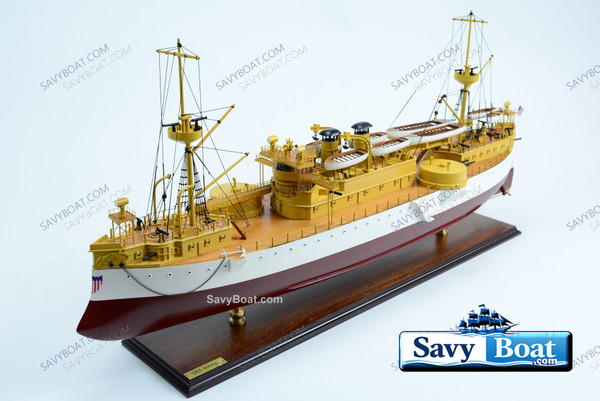
USS MAINE BATTLESHIP
SAVY DIRECT PRICE $899.96MSRP: $949.99USS MAINE SECOND CLASS BATTLESHIP FULLY BUILT AND READY TO DISPLAY, QUALITY SHIP MODEL Dimension Approx.: 32″L x 6.5″W x 14″H The model is already built, NOT a model ship kit Approximate scale...
Description

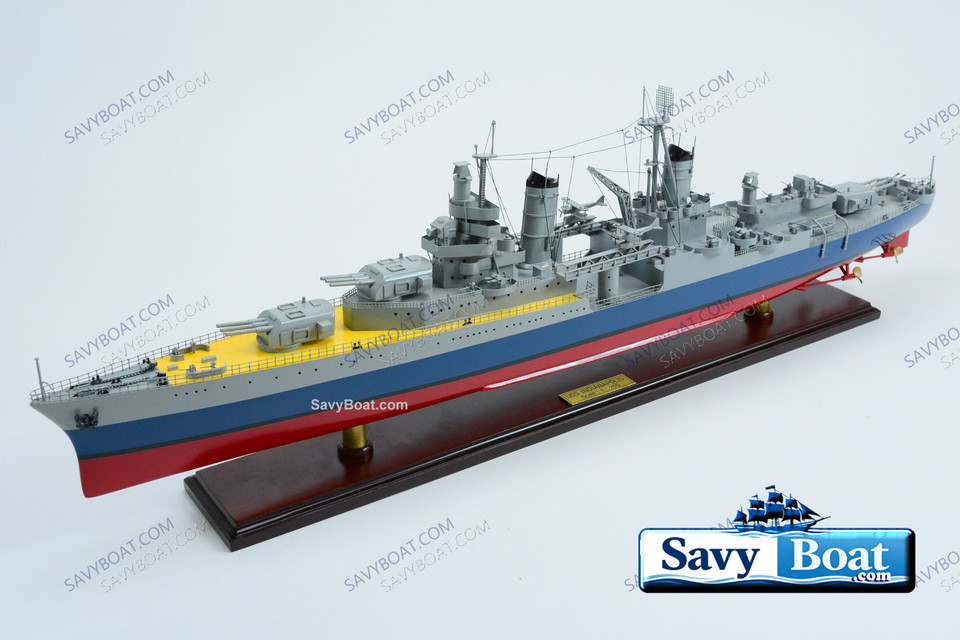
USS INDIANAPOLIS CL/CA-35 PORTLAND CLASS HEAVY CRUISER
FULLY BUILT AND READY TO DISPLAY MUSEUM QUALITY SHIP MODEL
- Dimension approx.: 36″ L x 4.5″ W x 10.5″ H
- The model is already built. THIS IS NOT A MODEL SHIP KIT
When the USS Indianapolis was laid down in Camden, New Jersey, in 1930, she represented the newest generation of American cruisers—fast, long‑ranged, and built to project U.S. naval power across the world’s oceans. Launched in November 1931 and commissioned the following year, she measured 610 feet, displaced nearly 10,000 tons, and carried a formidable battery of nine 8‑inch guns. Though originally classified as a light cruiser due to treaty‑driven armor limitations, she was soon reclassified as a Portland‑class heavy cruiser, reflecting her true role as a hard‑hitting fleet combatant.
In the years before World War II, Indianapolis served as flagship of the Navy’s Scouting Force and frequently hosted President Franklin D. Roosevelt, becoming a symbol of American presence during a tense global era. When war came, she moved to the Pacific, where her speed and firepower made her a vital asset in campaign after campaign. She supported operations in the Aleutians, the Gilbert and Marshall Islands, and the Mariana and Palau campaigns, and she played a key role in the Battle of the Philippine Sea, helping protect carriers whose aircraft shattered Japanese naval aviation. In early 1945, she supported the landings at Iwo Jima, her guns thundering in support of Marines fighting ashore.
But her most consequential mission came that summer. In July 1945, Indianapolis was assigned a top‑secret task: deliver critical components of the atomic bomb “Little Boy” to Tinian Island. She raced across the Pacific at high speed, completing the mission in record time—an operation that directly contributed to the end of the war. Few aboard knew the significance of the cargo they carried.
Her triumph was followed by tragedy.
On July 30, 1945, while sailing from Guam toward Leyte, Indianapolis was struck by two torpedoes from the Japanese submarine I‑58. The cruiser sank in 12 minutes. Roughly 300 men went down with the ship; the remaining 890 were cast into the open ocean with few lifeboats, little water, and no immediate rescue. For nearly four days, they endured dehydration, exposure, hallucinations, and shark attacks in one of the most harrowing ordeals in naval history. When rescue finally arrived, only 316 survivors remained—making the sinking of Indianapolis the deadliest loss of life from a U.S. warship at sea.
In the aftermath, Captain Charles B. McVay III was court‑martialed, accused of failing to zigzag—despite testimony from the Japanese submarine commander that zigzagging would not have changed the outcome. For decades, survivors fought to clear McVay’s name. In 2000, Congress formally exonerated him, and in 2001, the Navy acknowledged his absolution.
The ship’s final chapter came in 2017, when a team funded by Paul Allen discovered the wreck in the Philippine Sea, resting at a depth of 18,000 feet. The find brought closure to a story long marked by loss and mystery. In 2018, the crew of Indianapolis received the Congressional Gold Medal, honoring their service and sacrifice.
Today, the USS Indianapolis stands as one of the most powerful symbols of courage and tragedy in American naval history. Her service spanned the rise of U.S. sea power, her secret mission helped end World War II, and her loss remains a solemn reminder of the human cost of war. Her legacy endures—in museums, memorials, and in the memories of the men who survived her final hours.


