





-

USS CONSTELLATION TALL SHIP
SAVY DIRECT PRICE $999.96MSRP: $1,099.99USS CONSTELLATION TALL SHIP FULLY BUILT AND READY TO DISPLAY MUSEUM QUALITY SHIP MODEL Dimension approx.: 36″ L x 11″ W x 26″ H The model is already built. THIS IS NOT A MODEL SHIP KIT -
 img:new-low-5-bottom-with-special-offer-08042026.pngimg:new-low-5-bottom-with-special-offer-08042026.png
USS RATTLESNAKE TALL SHIP
SAVY DIRECT PRICE $100.00 - $769.96USS RATTLESNAKE TALL SHIP FULLY BUILT AND READY TO DISPLAY, QUALITY SHIP MODEL Dimension approx.: 28″ (long) x 9″ (wide) x 20″ (high) The model is already built. THIS IS NOT A MODEL SHIP KIT -

USS RATTLESNAKE TALL SHIP (NO SAILS)
SAVY DIRECT PRICE $769.96MSRP: $829.99USS RATTLESNAKE TALL SHIP (NO SAILS) FULLY BUILT AND READY TO DISPLAY, QUALITY SHIP MODEL Dimension approx.: 28″ (long) x 9″ (wide) x 20″ (high) The model is already built. THIS IS NOT A MODEL...
Description

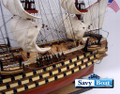
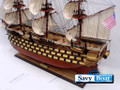
USS PENNSYLVANIA TALL SHIP
FULLY BUILT AND READY TO DISPLAY MUSEUM QUALITY SHIP MODEL
- Dimension approx.: 37.5″L x 9.5″W x 29″H
- The model is already built. THIS IS NOT A MODEL SHIP KIT
Long before steel hulls and turbine engines defined American sea power, the United States Navy built a wooden giant meant to stand shoulder‑to‑shoulder with the greatest warships of Europe. That ship was the USS Pennsylvania, launched on 18 July 1837, and remembered as the largest sailing warship ever constructed for the United States. She was a three‑decked ship‑of‑the‑line, a towering symbol of national ambition in an era when naval prestige was measured in guns, timber, and the ability to dominate a line of battle.
Authorized by Congress in 1816, Pennsylvania was designed by naval architect Samuel Humphreys and built at the Philadelphia Navy Yard. Her construction stretched over sixteen years—slowed by budget constraints but driven by a desire to match the first‑rate ships of the British Royal Navy. When she finally emerged, she was immense: 210 feet long, nearly 57 feet of beam, and displacing over 3,200 tons. Her armament was staggering for an American vessel of the time—up to 136 guns, including powerful 32‑pounders and 8‑inch shell guns. She was, in every sense, a floating fortress.
Yet despite her size and promise, Pennsylvania lived a surprisingly quiet life. She completed only a single voyage—from Delaware Bay to the Norfolk Navy Yard—before being laid up. The age of great sailing battle fleets was already fading, and the United States had little need for such a massive ship‑of‑the‑line during the relatively calm decades before the Civil War. Instead, she became a receiving ship, serving as a stationary housing and administrative vessel for sailors awaiting assignment.
Her end came not in battle, but in the chaos of the American Civil War. In 1861, as Union forces evacuated the Norfolk Navy Yard to prevent its capture by Confederate troops, Pennsylvania was burned along with other ships to deny her use to the enemy. The largest sailing warship ever built for the United States was consumed by flames—an abrupt and somber conclusion to a vessel intended for grandeur.
Though she never fired her guns in anger, the USS Pennsylvania remains a landmark in American naval history. She represented the peak of U.S. naval architecture in the age of sail—an era when power was expressed through towering masts, broadside batteries, and the craftsmanship of shipwrights working in oak and pine. Her massive size, heavy armament, and ambitious design reflected a young nation’s desire to stand among the world’s great naval powers.
Today, she is remembered as a symbol of American maritime aspiration—an extraordinary ship whose brief service nonetheless marks an important chapter in the evolution of the U.S. Navy.


