












-

USNS COMFORT (T-AH-20) US NAVY HOSPITAL SHIP
SAVY DIRECT PRICE $879.96MSRP: $979.99USNS COMFORT (T-AH-20) US NAVY HOSPITAL SHIP FULLY BUILT AND READY TO DISPLAY MUSEUM QUALITY SHIP MODEL -

USS HAVEN (AH-12) NAVY HOSPITAL SHIP
SAVY DIRECT PRICE $899.96MSRP: $949.99USS HAVEN (AH-12) HOSPITAL SHIP FULLY BUILT AND READY TO DISPLAY MUSEUM QUALITY SHIP MODEL Dimension approx.: 40″L x 6″W x 13″H The model is already built. THIS IS NOT A MODEL SHIP KIT USS -

HMHS BRITANNIC LIGHTED HOSPITAL SHIP
SAVY DIRECT PRICE $1,099.96MSRP: $1,199.99HMHS BRITANNIC LIGHTED OCEAN LINER HOSPITAL SHIP FULLY BUILT AND READY TO DISPLAY MUSEUM QUALITY SHIP MODEL BEAUTIFUL MUSEUM QUALITY MODEL Dimension approx.: 40.5″ (long) x 5″ (wide) x 13.5″...
Description

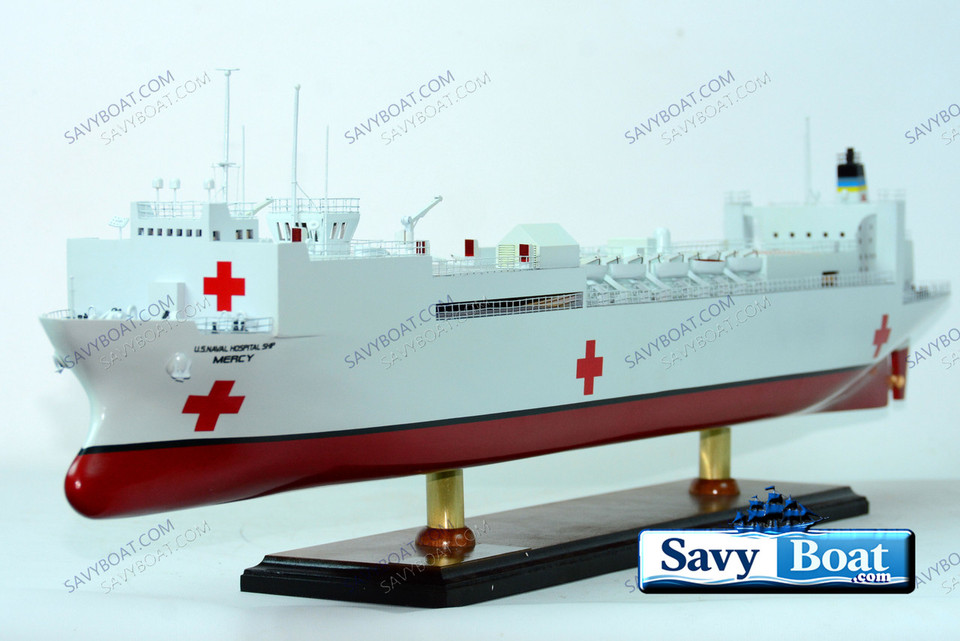
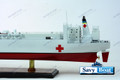
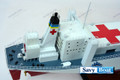
USNS MERCY (T-AH-19) US NAVY HOSPITAL SHIP
FULLY BUILT AND READY TO DISPLAY MUSEUM QUALITY SHIP MODEL
- Dimension approx.: 36″L x 5″W x 10″H
- The model is already built. THIS IS NOT A MODEL SHIP KIT
A Modern Hospital Ship Carrying Hope Across the Pacific
USNS Mercy (T‑AH‑19) began her life far from the humanitarian mission she would one day embody. Laid down in 1976 as the commercial oil tanker SS Worth, she spent her early years hauling crude across the world’s oceans. But in the early 1980s, as the U.S. Navy sought to create large, self‑contained medical platforms capable of supporting both combat operations and disaster relief, Worth was selected for a dramatic transformation. In July 1984, at the same San Diego shipyard where she had been built, she entered a 35‑month conversion that would turn her into one of the largest hospital ships ever constructed.
Launched as USNS Mercy on 20 July 1985 and placed in service the following year, she emerged as a floating medical center nearly 900 feet long, displacing over 65,000 tons, and capable of caring for 1,000 patients. Her facilities rivaled those of major land‑based hospitals: 12 operating rooms, an 80‑bed ICU, radiology suites, laboratories, a pharmacy, optometry, dental care, and a helicopter deck to receive casualties from sea or shore. Operated by the Military Sealift Command, she normally remained in Reduced Operating Status—quietly waiting, with a small crew of civilian mariners and Navy medical personnel ready to bring her to life when needed.
Her first major voyage came in 1987, when she sailed from the U.S. West Coast on a combined training and humanitarian mission. Over months at sea, she treated tens of thousands of patients across the Philippines, Papua New Guinea, Fiji, and other Pacific communities. Her arrival in each port brought crowds seeking care—children with untreated conditions, families needing surgery, and communities grateful for medical support rarely available in remote regions.
From that point forward, Mercy became a cornerstone of the Navy’s humanitarian presence in the Indo‑Pacific. Her primary mission remained military—providing acute surgical and medical support to deployed forces—but her most visible work often came in times of crisis. She responded to natural disasters, partnered with organizations like Operation Smile, and became a central platform for Pacific Partnership, the Navy’s annual multinational humanitarian assistance mission. In recent years, she has deployed repeatedly across the region, offering medical care, training, and disaster‑preparedness support to partner nations.
Though she carries no offensive weapons, Mercy is a powerful symbol of American capability—proof that naval strength can be measured not only in firepower, but in compassion. She is the third U.S. Navy ship to bear the name, following hospital ships of World War I and World War II, and she continues that legacy with every mission she undertakes.
Today, USNS Mercy stands as one of the world’s most capable afloat hospitals, a vessel that brings relief, expertise, and hope wherever she sails. Whether supporting combat operations or delivering humanitarian aid, she represents the Navy’s commitment to saving lives across the globe—an enduring reminder that even in a modern fleet of steel and technology, some ships are built not to fight, but to heal.


