







-

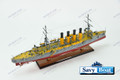
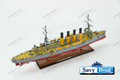
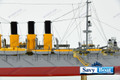
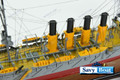
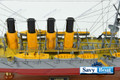
VARYAG RUSSIAN PROTECTED CRUISER (green hull)
SAVY DIRECT PRICE $799.96MSRP: $849.99VARYAG RUSSIAN PROTECTED CRUISER (green hull) FULLY BUILT AND READY TO DISPLAY MUSEUM QUALITY SHIP MODEL Dimension approx.: 31″ (long) x 5.5″ (wide) x 13″ (high) Approx Scale 1:160< -

PYOTR VELIKIY RUSSIAN BATTLECRUISER
SAVY DIRECT PRICE $749.96MSRP: $799.99PYOTR VELIKIY RUSSIAN BATTLECRUISER FULLY BUILT AND READY TO DISPLAY, QUALITY SHIP MODEL Dimension approx.: 39L x 5.5W x 13H The model is already built. THIS IS NOT A MODEL SHIP KIT When the keel... -

KORIETZ (KOPEEц) RUSSIAN WAR SHIP
SAVY DIRECT PRICE $999.96MSRP: $1,099.99KORIETZ (KOPEEц) RUSSIAN WAR SHIP FULLY BUILT AND READY TO DISPLAY HIGH QUALITY SHIP MODEL Dimension approx.: 34″ (long) x 9″ (wide) x 23″ (high) The model is already built. THIS IS NOT A MODEL...
Description

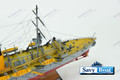
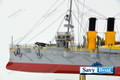
VARYAG RUSSIAN PROTECTED CRUISER (red hull)
FULLY BUILT AND READY TO DISPLAY MUSEUM QUALITY SHIP MODEL
- Dimension approx.: 31″ (long) x 5.5″ (wide) x 13″ (high)
- Approx Scale 1:160
- The model is already built. THIS IS NOT A MODEL SHIP KIT
When the Varyag slid down the ways at the William Cramp & Sons shipyard in Philadelphia in 1899, she represented the Russian Empire’s ambition to modernize its fleet at the dawn of the 20th century. Ordered in 1898 and commissioned in January 1901, the sleek protected cruiser—stretching 129.5 meters and displacing roughly 6,500 tons—was built for speed, long‑range patrols, and the projection of Russian naval presence in the Pacific. Her twelve 152 mm guns, quick‑firing secondary batteries, and torpedo tubes made her one of the most formidable cruisers in Russia’s Far Eastern squadron.
Assigned to the Russian Pacific Fleet, Varyag soon found herself stationed at Port Arthur, a flashpoint of rising tensions between Russia and Japan. When the Russo‑Japanese War erupted in early 1904, she was dispatched to Chemulpo Bay (modern Incheon) to protect Russian interests and maintain a presence in Korea. It was there, on February 9, 1904, that Varyag faced the moment that would define her legacy.
That morning, a powerful Japanese squadron blocked the harbor entrance and demanded that the Russian ships—Varyag and the gunboat Korietz—either leave or be interned. Outnumbered and outgunned, Captain Vsevolod Rudnev chose to fight. With her band playing and crew at battle stations, Varyag steamed out to meet a force she could not hope to defeat.
The Battle of Chemulpo Bay was short but ferocious. Varyag’s gunners fought with determination, firing salvo after salvo as shells rained down upon her. Fires broke out, casualties mounted, and her steering and guns were crippled. Yet she refused to strike her colors. Unable to continue the fight and unwilling to surrender his ship, Rudnev ordered Varyag scuttled in the harbor. Her crew evacuated to neutral vessels, leaving their battered cruiser to settle beneath the waves—a deliberate act of defiance that resonated across Russia.
The story of Varyag’s stand became a national symbol of courage. Songs, poems, and military honors celebrated her crew’s refusal to yield. Her bell, now displayed at the Central Naval Museum in Saint Petersburg, remains one of the most revered artifacts of the Russian Navy.
But Varyag’s story did not end at Chemulpo. The Japanese later salvaged the wreck, refitted her, and commissioned her into the Imperial Japanese Navy as Soya. She served for years under the rising sun before being returned to Russia in 1916, a strange homecoming for a ship once scuttled in defiance of Japanese capture. After the turmoil of revolution and war, she eventually faded from service, but her legend endured.
Today, the Varyag stands as one of the most iconic ships of the Russo‑Japanese War—a vessel remembered not for victory, but for valor. Her final battle at Chemulpo Bay remains a powerful example of duty, sacrifice, and the fierce pride of sailors who chose honor over surrender.


