









-

USS FLETCHER (DD-445) WWII DESTROYER
SAVY DIRECT PRICE $899.96MSRP: $999.99USS FLETCHER (DD-445) WWII DESTROYER FULLY BUILT AND READY TO DISPLAY MUSEUM QUALITY SHIP MODEL Dimension approx.: 39L x 5W x 12H The model is already built. THIS IS NOT A MODEL SHIP KIT When war... -

USS FLETCHER (DD-445) WWII DESTROYER (CAMO)
SAVY DIRECT PRICE $949.96MSRP: $1,049.99USS FLETCHER (DD-445) WWII DESTROYER (CAMO) FULLY BUILT AND READY TO DISPLAY MUSEUM QUALITY SHIP MODEL Dimension approx.: 39L x 5W x 12H The model is already built. THIS IS NOT A MODEL SHIP... -

USS GEARING (DD-710) - GEARING CLASS DESTROYER
SAVY DIRECT PRICE $899.96MSRP: $999.99USS GEARING (DD-710) - GEARING CLASS DESTROYER FULLY BUILT AND READY TO DISPLAY MUSEUM QUALITY SHIP MODEL Dimension approx.: 31.5″L x 4″W x 11″H The model is already built. THIS IS NOT A MODEL...
Description

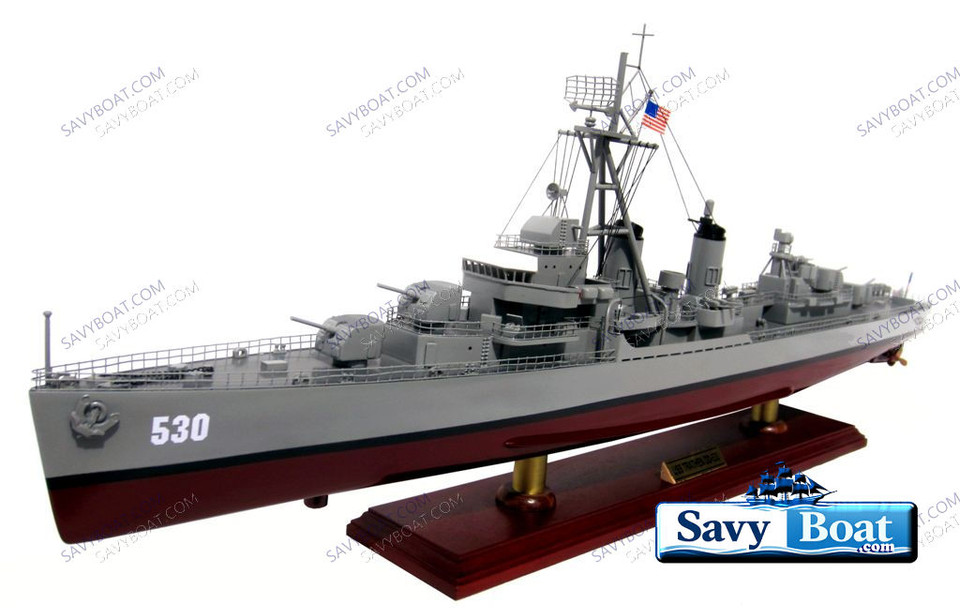
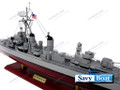
USS TRATHEN (DD-530) WWII FLETCHER CLASS DESTROYER
FULLY BUILT AND READY TO DISPLAY MUSEUM QUALITY SHIP MODEL
- Dimension approx.: 31.5″L x 4″W x 11″H
- The model is already built. THIS IS NOT A MODEL SHIP KIT
When the USS Trathen (DD‑530) slid down the ways at Bethlehem Shipbuilding in San Francisco on 22 October 1942, she joined the largest and most capable destroyer class the United States had ever built. Named for Lt. Cmdr. James Trathen, a Civil War officer known for steady leadership, the ship carried that legacy into a new era of naval warfare. Commissioned on 28 May 1943 under Commander Alvoord J. Greenacre, Trathen quickly proved herself a fast, responsive, and sharp‑eyed asset in the Pacific.
After shakedown and training in Hawaiian waters, she joined Rear Admiral Willis A. “Ching” Lee’s task force for the reoccupation of Baker Island in late 1943. Though the operation was small compared to the great amphibious assaults to come, Baker Island was strategically vital—a forward base for reconnaissance flights probing the Japanese‑held Gilberts. Here Trathen demonstrated one of the Fletcher class’s greatest strengths: versatility. She provided fighter‑direction services, guiding F6F Hellcats from Belleau Wood and Princeton toward incoming threats. Under her direction, American pilots intercepted and destroyed two Japanese Kawanishi H8K “Emily” flying boats, preventing them from reporting U.S. movements.
Her next assignment placed her in the thick of carrier operations. On 29 September 1943, Trathen joined Task Group 14.5, a fast carrier force bound for Wake Island under Rear Admiral Alfred E. Montgomery. During the 5–6 October strikes, the carriers launched 738 combat sorties, while battleships and cruisers delivered heavy bombardment. Trathen screened the carriers, guarded against submarine threats, and kept station amid the high‑tempo operations that defined the Pacific air‑sea war.
A cracked high‑pressure turbine forced her back to Pearl Harbor for temporary repairs, then onward to Bremerton for permanent work. But like many Fletchers, she returned to service ready for more. After the war, she was decommissioned in January 1946, only to be recommissioned in August 1951 as Cold War tensions reshaped the Navy’s needs. For more than a decade she served in the Pacific, a reliable destroyer in an era of rapid technological change.
Her long career ended in 1965, when she was decommissioned for the final time. Stricken in 1972, she met her fate as a target hulk in November 1973, then was scrapped—an honorable end for a ship that had spent her life protecting carriers, guiding fighters, and standing watch across the Pacific.
Today, USS Trathen is remembered as one of the many Fletcher‑class destroyers whose speed, firepower, and adaptability helped turn the tide in the Pacific. Her role in the Baker Island operation and the Wake Island strikes reflects the quiet but essential work of destroyers—ships that guarded the fleet, hunted threats, and ensured that the carriers could deliver the blows that defined the war.


