









-
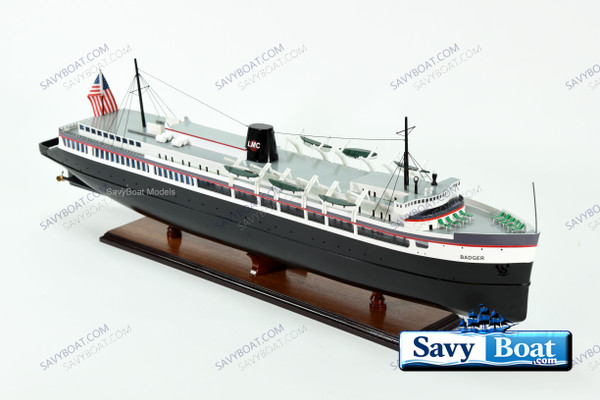
SS BADGER GREAT LAKE FERRY
SAVY DIRECT PRICE $699.96MSRP: $749.99SS BADGER GREAT LAKE FERRY FULLY BUILT AND READY TO DISPLAY SHIP MODEL Dimension approx.: 36″ L x 7″ W x 11″ H The model is already built. THIS IS NOT A MODEL SHIP KIT When the -

ARTHUR ANDERSON GREAT LAKE FREIGHTER
SAVY DIRECT PRICE $724.96MSRP: $774.99SS ARTHUR M ANDERSON GREAT LAKE FREIGHTER SHIP FULLY BUILT AND READY TO DISPLAY HIGH QUALITY SHIP MODEL This beautiful model is already built, NOT a kit. approx 36″ (high) x 4″ (wide) x 7″... -

SS BRASIL STEAM SHIP
SAVY DIRECT PRICE $999.96MSRP: $1,099.99SS Brasil 1957, Moore-McCormack Lines FULLY BUILT AND READY TO DISPLAY MUSEUM QUALITY SHIP MODEL BEAUTIFUL MUSEUM QUALITY MODEL Open die cut side hull windows, NOT painted like those built by most...
Description

SS THUNDER BAY GREAT LAKES SHIP
FULLY BUILT AND READY TO DISPLAY MUSEUM QUALITY SHIP MODEL
- Dimension approx.: 36″L x 4″W x 10″H
- The model is already built. THIS IS NOT A MODEL SHIP KIT
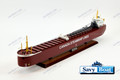
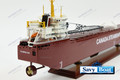
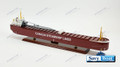
When the SS Thunder Bay slid down the ways at Chengxi Shipyard in Jiangyin, China, on 13 May 2013, she represented a new chapter in Great Lakes shipping. Built for Canada Steamship Lines (CSL) as part of the innovative Trillium‑class, she was designed not merely as another bulk carrier, but as a symbol of the future—cleaner, more efficient, and engineered for the evolving demands of 21st‑century lake commerce.
At 225.5 meters long and nearly 24 meters wide, the Thunder Bay carries the unmistakable profile of a modern laker: a high forward deckhouse, a long, purposeful hull, and a self‑unloading boom stretching along her starboard side. Beneath her steel skin, a powerful MAN B&W 6S50ME Tier III diesel engine drives her across the inland seas with 8,750 kW of force, pushing thousands of tonnes of ore, grain, or aggregate through the Great Lakes system with quiet, fuel‑efficient precision. Her five cavernous holds can carry more than 34,000 tonnes, and her conveyor system can unload at an impressive 5,450 tonnes per hour, allowing her to turn around cargoes with remarkable speed.
The Thunder Bay made her first voyage through the Saint Lawrence Seaway in July 2013, and on 8 August she loaded her inaugural cargo—iron ore pellets bound from Escanaba to Quebec City. A month later, on 27 September 2013, she reached her namesake port in Thunder Bay, Ontario, tying modern steel to a place whose maritime identity stretches back centuries.
Though she is a vessel of the present, the Thunder Bay carries a name steeped in Great Lakes history. The region’s waters—now protected within the Thunder Bay National Marine Sanctuary—hold more than a hundred shipwrecks, preserved in cold freshwater as silent witnesses to the age of wooden schooners, early steamers, and steel freighters that once crowded the same routes she sails today. Archives such as the Great Lakes Maritime Collection and the Thunder Bay Research Collection preserve the stories of those earlier vessels, creating a bridge between the industrial past and the modern fleet that continues to power the region’s economy.
In this way, the SS Thunder Bay stands as both a technological achievement and a tribute. She embodies the efficiency and environmental responsibility demanded of contemporary shipping, yet her name echoes the long lineage of mariners, shipbuilders, and communities shaped by the Great Lakes. Every time she rounds Whitefish Bay or threads the St. Clair River, she sails in the wake of generations—carrying forward a tradition that remains vital, resilient, and deeply rooted in the history of the inland seas.


