






-

SS POSEIDON OCEAN LINER
SAVY DIRECT PRICE $999.96MSRP: $1,099.99SS POSEIDON OCEAN LINER FULLY BUILT AND READY TO DISPLAY, HIGH QUALITY SHIP MODEL Dimension Approx.: 36.5″ L x 4.5″ W x 11.5″ H The model is already built, NOT a model -
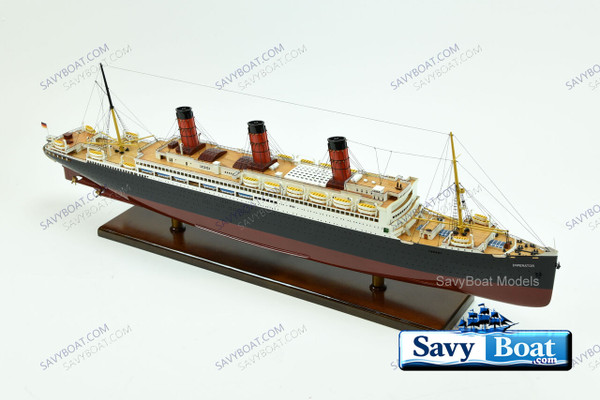
SS IMPERATOR OCEAN LINER
SAVY DIRECT PRICE $999.96MSRP: $1,099.99SS IMPERATOR OCEAN LINER FULLY BUILT AND READY TO DISPLAY MUSEUM QUALITY SHIP MODEL This beautiful model is already built, NOT a kit. Dimensions approx: 38″ L x 4.5″ W x 12″ H – Scale 1/285. When... -

SS ROTTERDAM OCEAN LINER
SAVY DIRECT PRICE $799.96MSRP: $849.99SS ROTTERDAM OCEAN LINER HOLLAND AMERICA LINES FULLY BUILT AND READY TO DISPLAY MUSEUM QUALITY SHIP MODEL Dimension approx.: 37″ L x 6″ W x 13.5″ H The model is already built. THIS IS NOT A MODEL...
Description

SS STAVANGERFJORD OCEAN LINER
FULLY BUILT AND READY TO DISPLAY, QUALITY SHIP MODEL
- Dimension approx.: 40″ (long) x 6″ (wide) x 15″ (high)
- The model is already built. THIS IS NOT A MODEL SHIP KIT
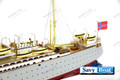
When the SS Stavangerfjord slipped into the water at Cammell Laird’s yard in Birkenhead on 21 May 1917, she represented a new chapter for the Norwegian America Line. Built during the final years of World War I and entering service in April 1918, she was designed not as a grand showpiece of imperial ambition, but as a dependable, modern bridge between Norway and North America — a lifeline for emigrants, travelers, and families separated by the Atlantic.
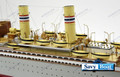
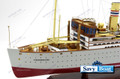
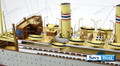
Measuring 532 feet with a 64‑foot beam and 13,156 gross tons, she was a handsome, well‑balanced liner with two masts, two funnels, and a purposeful profile. Her twin‑screw quadruple‑expansion engines, driving eight cylinders and producing 1,567 nominal horsepower, pushed her along at 16 knots — not the fastest on the Atlantic, but steady, economical, and reliable. Below her decks, eight single‑ended boilers with 32 corrugated furnaces fed her engines, first with coal and, after 1924, with cleaner, more efficient oil.
Inside, she was built for comfort rather than ostentation. With accommodations for 88 first‑class, 318 second‑class, and 820 third‑class passengers, she carried a cross‑section of Norwegian society: businessmen, students, families, and hopeful emigrants. Her dining saloon, music room, and smoking room offered warmth and familiarity, while electric lighting and wireless telegraphy placed her firmly among the modern liners of her era. For countless Norwegian‑American travelers, she became the preferred way home — a ship whose very name evoked trust.
Her service pattern was steady and deeply rooted: the Oslo–Bergen–New York route, with occasional calls at Stavanger and Kristiansand. Her maiden voyage was unusual — eastbound from New York to Norway — making her the only European liner to begin service by sailing toward home rather than away from it. Over the decades, she became a familiar sight in both Norwegian fjords and New York Harbor, her arrivals and departures marking the rhythm of transatlantic life.
World War II interrupted that rhythm. When German forces occupied Norway, Stavangerfjord was seized in Oslo and used as a depot and troop ship, her graceful passenger spaces repurposed for military needs. She survived the war intact and returned to civilian service in August 1945, once again carrying travelers across the Atlantic as Norway rebuilt and reconnected with the world.
Her long career was not without drama. In December 1953, she lost her rudder in a violent Atlantic storm — a potentially catastrophic failure — yet her crew managed to nurse her safely home, reinforcing her reputation for resilience. Plans to retire her in 1956 were quietly set aside; passengers still loved her, and she continued sailing until December 1963, completing her final voyage in February 1965. After nearly half a century of service, she was sold for scrap and broken up in Hong Kong by Patt, Manfield & Co. Ltd.
Today, the SS Stavangerfjord is remembered as one of the longest‑serving ships of the Norwegian America Line — a vessel that carried generations of Norwegians to new lives, reunited families, and maintained a cultural bridge across the ocean. Her passenger lists, photographs, and brochures remain invaluable to genealogists and maritime historians, preserving the story of a ship that faithfully crossed the Atlantic for more than forty years.
She was not the largest, nor the fastest, nor the most glamorous. But she was steady, beloved, and enduring — a true Norwegian workhorse of the North Atlantic.


