









-

MS KUNGSHOLM OCEAN LINER
SAVY DIRECT PRICE $999.96MSRP: $1,049.99MS KUNGSHOLM OCEAN LINER FULLY BUILT AND READY TO DISPLAY MUSEUM QUALITY SHIP MODEL Dimension approx.: 40″ (long) x 4.75″ (wide) x 12″ (high) The model is already built. THIS IS NOT A MODEL SHIP... -

MS ACHILLE LAURO OCEAN LINER
SAVY DIRECT PRICE $899.96MSRP: $999.99MS ACHILLE LAURO OCEAN LINER FULLY BUILT AND READY TO DISPLAY, HIGH QUALITY SHIP MODEL Dimension Approx.: 40L x 6W x 14H The model is already built, NOT a model ship kit The ship -
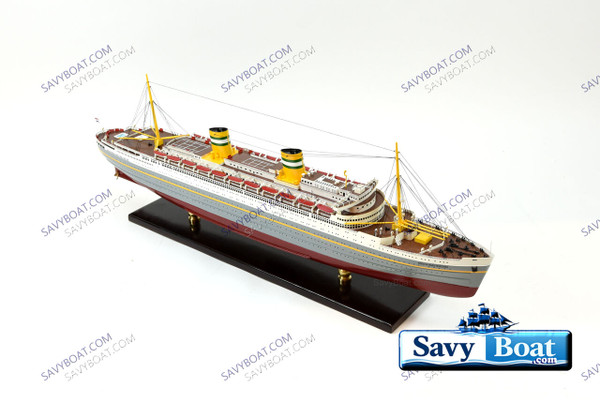
SS NIEUW AMSTERDAM DUTCH OCEAN LINER (GRAY)
SAVY DIRECT PRICE $899.96MSRP: $999.99SS NIEUW AMSTERDAM DUTCH OCEAN LINER GRAY FULLY BUILT AND READY TO DISPLAY, QUALITY SHIP MODEL Dimension Approx.: 36.5″L x 4.75″W x 12″H Approximately 1:250 scale The model is already built, NOT a...
Description

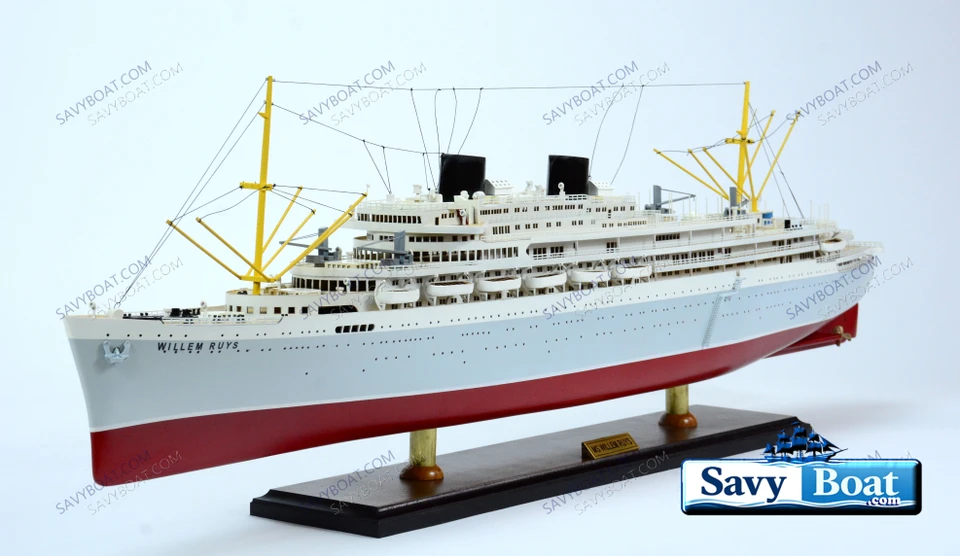
WILLEM RUYS DUTCH OCEAN LINER
FULLY BUILT AND READY TO DISPLAY MUSEUM QUALITY SHIP MODEL
- Dimension approx.: 37.5″L x 5″W x 11.5″H
- The model is already built. THIS IS NOT A MODEL SHIP KIT
When the Willem Ruys finally entered the water on 1 July 1946, she carried the weight of a world that had been interrupted. Ordered in 1938 by Royal Rotterdam Lloyd as a modern replacement for aging East Indies liners, her keel was laid in 1939 at the De Schelde shipyard in Vlissingen. But war swept across Europe before she could take shape. Construction halted, her hull was damaged by bombing raids, and during the German occupation, attempts to complete her were slowed by deliberate sabotage from Dutch resistance workers. By the time she was finished in late 1947, she had already lived a lifetime of struggle.
Named for Willem Ruys, the grandson of the company’s founder—executed by German forces during the war—the ship became a symbol of Dutch resilience. At 192 meters long, with a beam of 25 meters and a gross register tonnage of 21,119, she was one of the most advanced liners of her era. Her interiors blended Art Deco elegance with emerging mid‑century modern design, and her innovative low‑slung aluminum lifeboats, integrated into the superstructure, would later inspire ships like the SS Canberra.
When she sailed on her maiden voyage on 5 December 1947, the Willem Ruys became the pride of Royal Rotterdam Lloyd. She ran the Netherlands–Dutch East Indies route, often alongside her running mate MS Oranje, carrying passengers, emigrants, diplomats, and families across the postwar world. Her passenger list included notable figures such as Lee Kuan Yew, future Prime Minister of Singapore, and British diplomat Harold Nicolson with his wife, writer Vita Sackville‑West.
Her career, however, was not without incident. On 6 January 1953, she collided with Oranje in the Red Sea due to miscommunication—an accident that damaged both ships but caused no loss of life. Later that same year, she collided with and sank the Dutch tanker Cornelis B in dense fog. Despite these setbacks, she remained a beloved flagship, known for her reliability and refined service.
By the mid‑1960s, the age of traditional ocean liners was fading. Air travel had reshaped global transportation, and Royal Rotterdam Lloyd sold the ship in 1965 to Italy’s Flotta Lauro Lines. Her transformation into a cruise ship marked the beginning of her second life. Rebuilt, modernized, and renamed Achille Lauro, she traded the structured schedules of liner service for the leisurely itineraries of Mediterranean cruising.
As Achille Lauro, she became one of the most recognizable cruise ships of her era—though her fame was shadowed by misfortune. She suffered several onboard fires, collisions, and mechanical issues. Most famously, in 1985, she was hijacked by militants from the Palestine Liberation Front, an event that drew global attention and left a lasting mark on maritime security history.
Her long career ended on 2 December 1994, when a fire broke out off the coast of Somalia. Despite evacuation efforts, the ship could not be saved. She burned for hours before sinking beneath the Indian Ocean, closing a story that had begun nearly six decades earlier in a Dutch shipyard interrupted by war.
Today, Willem Ruys is remembered as a ship of two identities: a pioneering postwar ocean liner that carried nations into a new era, and a cruise ship whose dramatic later life shaped international maritime policy. Her legacy spans continents, decades, and industries—an enduring testament to the evolution of passenger travel from the golden age of liners to the rise of modern cruising.


