







-
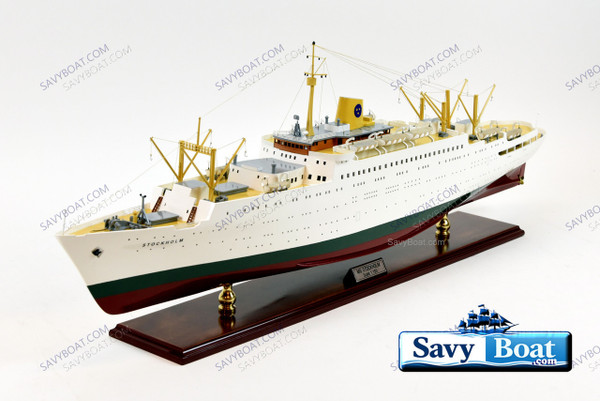
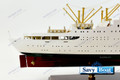
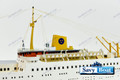
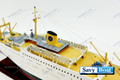
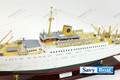
MS STOCKHOLM 32" PASSENGER SHIP
SAVY DIRECT PRICE $799.96MSRP: $899.99MS STOCKHOLM PASSENGER SHIP FULLY BUILT AND READY TO DISPLAY, QUALITY SHIP MODEL Open die cut side hull windows, NOT painted like those built by most other companies. Dimension Approx.: 32″L x 5... -

MS STOCKHOLM LIGHTED PASSENGER SHIP
SAVY DIRECT PRICE $1,099.96MSRP: $1,199.99MS STOCKHOLM LIGHTED PASSENGER SHIP FULLY BUILT AND READY TO DISPLAY, QUALITY SHIP MODEL Open die cut side hull windows, NOT painted like those built by most other companies. Dimension Approx.:... -

MS STOCKHOLM PASSENGER SHIP
SAVY DIRECT PRICE $899.96MSRP: $999.99MS STOCKHOLM PASSENGER SHIP FULLY BUILT AND READY TO DISPLAY MUSEUM QUALITY SHIP MODEL Open die cut side hull windows, NOT painted like those built by most other companies. Dimension Approx.: 40″L...
Description

MS STOCKHOLM LIGHTED PASSENGER SHIP
FULLY BUILT AND READY TO DISPLAY, QUALITY SHIP MODEL
- Open die cut side hull windows, NOT painted like those built by most other companies.
- Dimension Approx.: 32″L x 5.75″W x 15″H
- The model is already built, NOT a model ship kit
- LIGHTED - LED LIGHTS pre-installed (power supply not included)
When the MS Stockholm slid down the ways at Götaverken on 9 September 1946, she embodied Sweden’s postwar optimism. Ordered in 1944 while the war still raged, she was conceived as a practical, economical diesel liner for the Swedish America Line (SAL) — not a glamorous greyhound of the Atlantic, but a sturdy workhorse built to reconnect families and commerce between Gothenburg and New York. At just under 12,000 tons and carrying roughly 390 passengers in two classes, she was modest by transatlantic standards, yet she represented Sweden’s largest passenger ship to date and its most powerful diesel installation.
Her maiden voyage on 21 February 1948 marked the beginning of a dependable postwar career. For nearly a decade she crossed the North Atlantic, braving winter seas, carrying emigrants, tourists, and business travelers. She even played a small role in American immigration history: in 1955, she transported the final person ever processed through Ellis Island before the station closed.
The event that would define Stockholm’s name forever came on 25 July 1956. In dense fog off Nantucket, her reinforced ice‑breaking bow struck the Italian liner Andrea Doria, tearing a fatal wound in the larger ship’s starboard side. The Andrea Doria capsized and sank eleven hours later, taking 46 lives — the deadliest peacetime collision in Atlantic history.
Stockholm, though grievously damaged, remained afloat. Her crew assisted in rescue operations, taking aboard hundreds of survivors before limping back to New York under her own power. The image of her crushed bow became one of the most famous maritime photographs of the 20th century.
After repairs, she returned to service, but the collision ensured she would never again be seen as an ordinary liner.
By 1959, SAL sought newer tonnage and sold the ship. The following year she entered one of the most unusual chapters of her life: purchased by East Germany for 20 million Swedish krona and renamed Völkerfreundschaft — “People’s Friendship.”
From 1960 to 1985, she sailed from Rostock as a socialist cruise ship, carrying East German citizens to friendly ports in the Soviet bloc and beyond. Her voyages reflected Cold War diplomacy as much as leisure. She became a cultural symbol in East Germany, appearing in films, propaganda materials, and travel posters. Few Westerners realized that the ship once involved in the Andrea Doria disaster was now a flagship of communist tourism.
When East Germany retired her in the mid‑1980s, the ship began an extraordinary sequence of sales, rebuilds, and renamings — each one reshaping her identity:
-
Volker (1985–1986)
-
Fridtjof Nansen (1986–1993)
-
Italia I (1993–1994)
-
Italia Prima (1994–1998)
-
Valtur Prima (1998–2002)
-
Caribe (2002–2005)
-
Athena (2005–2013)
-
Azores (2013–2016)
-
Astoria (2016–2025)
During these decades she sailed under Italian, Panamanian, and Portuguese flags, serving markets from the Mediterranean to the Caribbean. She underwent major structural transformations — new engines, new superstructure lines, extended decks — yet her original hull remained the same Swedish steel laid down in 1944.
As Athena, she survived hurricanes. As Azores, she weathered the decline of small‑ship cruising. As Astoria, she became the oldest active ocean liner in the world, a living artifact of the postwar era still carrying passengers into the 21st century.
The COVID‑19 pandemic ended her operational life. Laid up after 2020, she lingered in legal limbo until 2025, when she was sold for scrap and towed to Ghent, Belgium. There, at the Galloo recycling yard, workers began dismantling a ship that had sailed for 77 years — a lifespan almost unheard of for a steel ocean liner.
Her story did not vanish entirely. Divers recovered her wreck bell from the Andrea Doria site in 1959, and maritime museums continue to recount her improbable career.
The MS Stockholm is remembered not for luxury or size, but for endurance. She survived a catastrophic collision, outlasted the Cold War, reinvented herself across continents, and remained in service longer than nearly any ocean liner of her generation. Her many names trace the political and commercial tides of the late 20th century, while her hull — battered, rebuilt, and repainted countless times — carried the same spirit from 1946 to 2025.
A ship that began as a modest Swedish liner became one of the most storied vessels in maritime history.


